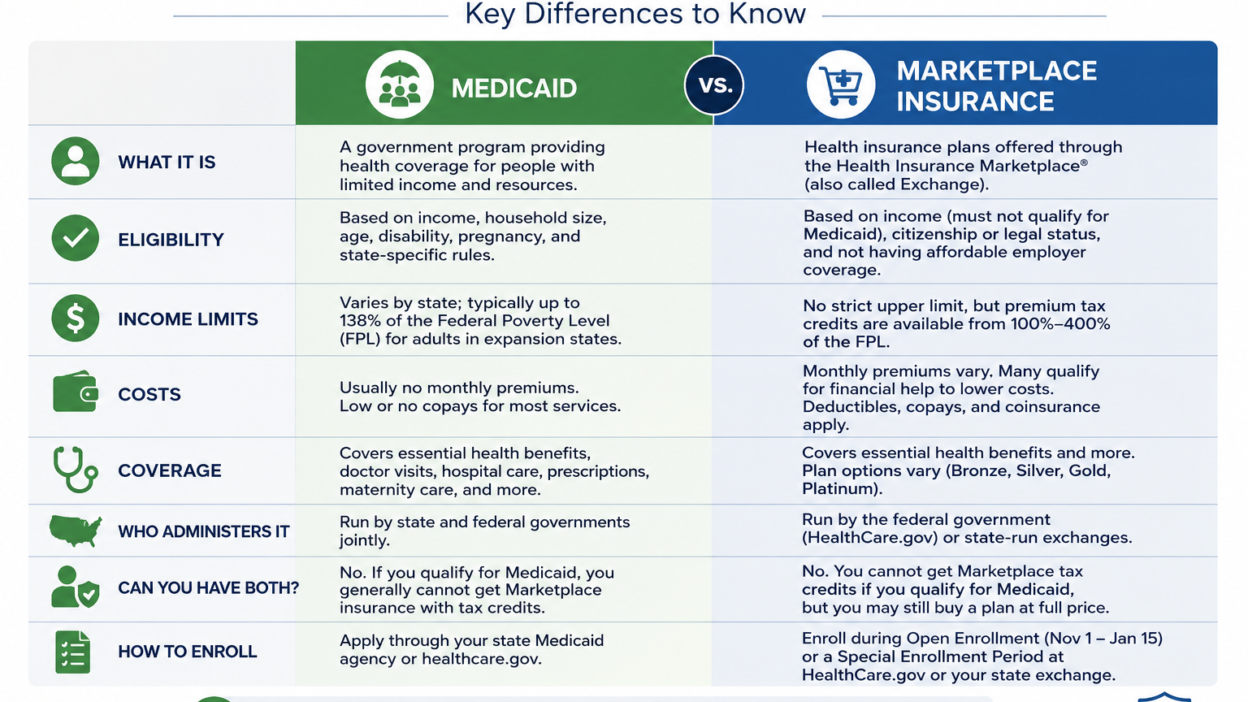
Understanding the differences between Medicaid and Marketplace insurance is essential for anyone navigating the complex landscape of healthcare coverage in the United States. Each option serves unique purposes and comes with its own set of eligibility requirements, which can significantly impact your access to necessary medical care. Therefore, knowing these differences not only helps in making informed decisions but also ensures that you select the best option tailored to your personal circumstances. As you explore your choices, consider factors such as income level, household size, and specific health needs. By so doing, you can better navigate the healthcare system and secure the coverage you need.
Key Points
- Medicaid eligibility is determined by income and family size, while Marketplace insurance considers various factors including projected annual income.
- Medicaid is often state-administered, differing widely in coverage and benefits, whereas Marketplace insurance is more uniform across states.
- Premium costs typically vary significantly between the two, with Medicaid usually having lower to no premiums compared to Marketplace plans.
- Open enrollment periods apply to Marketplace insurance, but Medicaid enrollment can occur year-round based on eligibility changes.
- Some individuals may qualify for both options, allowing them to choose based on their unique healthcare needs.
- Marketplace insurance may offer additional plan options, such as private insurance providers, compared to Medicaid.
- The types of services covered can differ, especially regarding long-term care and special medical needs under Medicaid.
Related content:
How Much Does Crop Insurance Cost Per Acre?
Understanding Medicaid: A Comprehensive Overview
Medicaid serves as a vital safety net for millions of Americans, offering health coverage to those who meet specific income and eligibility criteria. This government-funded program, administered at both the federal and state levels, encompasses a diverse range of medical services, including hospital visits, long-term care, and preventive care. However, understanding the nuances of Medicaid can be somewhat perplexing, yet crucial, particularly when contrasting it with options like Medicaid vs Marketplace Insurance.
To clarify the distinctions, consider the following points:
- Eligibility: Medicaid targets low-income individuals and families, while Marketplace Insurance is generally available to those with wider financial ranges.
- Cost: Medicaid typically involves lower out-of-pocket expenses, whereas Marketplace plans may require premiums and deductibles.
- Coverage Flexibility: Medicaid may limit provider choices, whereas Marketplace Insurance often allows for more flexibility in selecting healthcare providers.
Understanding these aspects helps individuals navigate their options effectively, especially in discussions about Medicaid vs Marketplace Insurance. Therefore, it’s essential to explore each program’s specifics to make informed health care decisions.
Exploring Marketplace Insurance: Key Features You Should Know
Marketplace insurance plays an essential role in ensuring a wide range of individuals and families have access to affordable healthcare. One key feature is the availability of various plans tailored to meet different needs and budgets. By offering tiers such as Bronze, Silver, Gold, and Platinum, consumers can select coverage that aligns with their expected healthcare usage.
Another crucial aspect is the potential for subsidies, which can significantly lower monthly premiums, depending on your income level. Unfortunately, many are unaware of how Medicaid vs Marketplace Insurance comparisons can affect their eligibility for these financial aids. Therefore, it’s important to assess your specific circumstances. Additionally, enrollment periods are time-sensitive, meaning you must take action within specific windows to secure your plan.
Overall, understanding these elements empowers you to navigate the complexities of choosing between Medicaid vs Marketplace Insurance effectively. Hence, being informed can lead to better health outcomes and financial security.
Income Requirements: Medicaid vs. Marketplace Insurance Explained
Understanding the income requirements for Medicaid vs Marketplace Insurance is essential for choosing the right healthcare coverage. Generally, Medicaid serves lower-income individuals and families, providing comprehensive services at little to no cost. In contrast, Marketplace Insurance caters to those with slightly higher incomes, who might qualify for premium subsidies based on their earnings. This distinction becomes crucial, as eligibility often hinges on specific income thresholds that can vary by state. Therefore, some individuals may find themselves in a grey area, not fitting neatly into either category. For example, if your income exceeds the Medicaid limits but remains below the thresholds for Marketplace subsidies, you may face unexpected challenges. Still, evaluating your options carefully can lead to better health coverage outcomes. Ultimately, understanding the nuances of Medicaid vs Marketplace Insurance can empower you to make informed decisions about your health care needs.
Categorical Eligibility: Who Qualifies for Medicaid?
Understanding Medicaid vs Marketplace Insurance eligibility can be intricate, as it involves various factors that differ by state. Generally, Medicaid targets low-income individuals and families, aiding those who traditionally struggle with healthcare costs.
Categorical eligibility typically hinges on several criteria:
- Income Level: Many states set a specific income threshold, often at or below 133% of the federal poverty level.
- Family Composition: Certain groups, like pregnant women, children, and individuals with disabilities, may qualify regardless of income.
- Residency Status: Applicants must generally be residents of the state in which they seek coverage.
This structure raises questions for some about the nuances between programs. For instance, whilst Medicaid often has broader eligibility criteria, the Medicaid vs Marketplace Insurance debate points to significant differences in coverage and benefits. Understanding these distinctions can help you navigate your options effectively.
Ultimately, while categorical eligibility provides a framework, local policies might introduce unexpected variables, adding layers of complexity to your journey toward health coverage.
Age and Disability Considerations: Differentiating Eligibility Criteria
Understanding the interplay between age and disability in relation to healthcare coverage is essential. Various factors influence eligibility, often leading to confusion. For instance, younger individuals with disabilities may find themselves navigating a landscape where Medicaid vs Marketplace Insurance options starkly differ. Age can play a crucial role; older adults often qualify for specific programs that are not available to their younger counterparts. Therefore, it is crucial to carefully assess one’s circumstances when considering coverage.
Moreover, age-related discounts or benefits might obscure the nuances of what is available through Medicaid vs Marketplace Insurance avenues. One must also consider how disability impacts access to these programs. Consequently, individuals may need to seek guidance on how both age and disability intersect with various eligibility criteria. Ultimately, researching and understanding these differences is vital for making informed decisions.
In summary, the distinction between Medicaid vs Marketplace Insurance eligibility based on age and disability warrants thorough examination, highlighting the importance of personalized information.
Residency Requirements: How They Affect Your Coverage Options
Understanding residency requirements is crucial for determining your healthcare coverage options. Depending on where you live, eligibility for different insurance plans may vary significantly. For instance, individuals might find themselves navigating between Medicaid vs Marketplace Insurance offerings, with each having its own stipulations based on state residency and income level.
Some states have expanded Medicaid, allowing a broader range of individuals to qualify. However, many states also operate their own Marketplace, which could present different plans and benefits. Therefore, if someone moves from one state to another, their eligibility may shift unpredictably.
“Your coverage options are significantly shaped by your residency status.”
In my opinion, understanding these nuances is essential; even slight changes in residency can open or close doors to appropriate healthcare. Hence, being informed of your rights and options is vital when considering Medicaid vs Marketplace Insurance plans.
Special Enrollment Periods: Navigating Opportunities for Coverage
Special Enrollment Periods (SEPs) present crucial opportunities for individuals to secure health coverage outside the standard Open Enrollment period. These windows can arise due to life events such as marriage, moving to a new address, or changes in income. Understanding how to navigate these moments is essential for ensuring access to healthcare when you need it most. However, many individuals may overlook their eligibility, leading to gaps in coverage.
To make the most of SEPs, consider the following:
- Event Awareness: Recognise the significant life changes that trigger an SEP.
- Application Timing: Be mindful of application deadlines to ensure you don’t miss the opportunity.
- Coverage Types: Evaluate the differences in Medicaid vs Marketplace Insurance to find the best option for your situation.
By staying informed about SEPs, you can better navigate the complexities of healthcare, paving the way for your informed choice between Medicaid vs Marketplace Insurance.
Ultimately, knowing your options empowers you to make decisions that best fit your needs, especially in light of evolving circumstances surrounding Medicaid vs Marketplace Insurance.
The Impact of Family Size on Eligibility for Medicaid and Marketplace Plans
Family size plays a crucial role in determining eligibility for both Medicaid and Marketplace plans. Typically, larger families may qualify for various benefits due to income limits that are adjusted based on household numbers. For instance, while a single individual might struggle to meet the income requirements, a family of four could have a much higher threshold, potentially granting them access to Medicaid.
However, the situation can be intricate. Depending on the state, the assessment process for Medicaid vs Marketplace Insurance may vary significantly. Furthermore, families must consider certain factors—such as age, income, and existing health conditions—that could influence their options. Therefore, it is advisable for families to assess their unique circumstances thoroughly. Despite the variances, understanding the interplay between family size and eligibility remains essential for making informed healthcare decisions.
Considerations for Families
| Family Size | Potential Medicaid Eligibility |
|---|---|
| 1 | Varies by state |
| 2 | Higher threshold |
| 3 | Likely eligible |
| 4+ | Increased chances |
Ultimately, understanding these factors can significantly impact a family’s decision-making process regarding Medicaid vs Marketplace Insurance options.
Making the Right Choice: Factors to Consider When Selecting Insurance
Choosing the right insurance plan can be a daunting task, especially when comparing options like Medicaid vs Marketplace Insurance. Start by evaluating your unique healthcare needs. Consider the types of services you frequently use, such as specialist visits or prescription medications. This assessment will pave the way for a more tailored choice.
Next, take a closer look at the financial implications. Premiums, deductibles, and out-of-pocket costs vary significantly between plans. Weigh these factors against your budget and financial stability; only then can you determine which option makes the most sense for you.
Lastly, think about the flexibility of each plan. Some may offer more comprehensive networks, while others could limit your choices. In the end, understanding the nuances of Medicaid vs Marketplace Insurance can lead you toward a well-informed decision that aligns with your healthcare goals.
Remember, the best insurance is one that matches your needs and circumstances.
You can also check these out.:
marketplace insurance vs medicaid: trying to understand …
Conclusion
In summary, navigating the complexities of Medicaid vs Marketplace Insurance can feel overwhelming, yet understanding their differences empowers individuals to make informed choices about their healthcare coverage. Each option offers unique benefits that cater to varying needs and financial situations. As you consider your options, keep in mind the importance of assessing factors like eligibility and coverage specifics. Ultimately, the right choice will depend on your circumstances, but arming yourself with knowledge is the first step towards securing the best possible health insurance for you and your family.
Frequently Asked Questions
What is Medicaid?
Medicaid is a state and federal programme that provides health coverage to eligible individuals and families with low income, including children, pregnant women, elderly individuals, and people with disabilities.
What is Marketplace Insurance?
Marketplace Insurance refers to health plans offered through the Health Insurance Marketplace, established under the Affordable Care Act (ACA), where individuals can compare and purchase insurance plans based on their needs and income.
Who is eligible for Medicaid?
Eligibility for Medicaid varies by state, but it generally covers low-income individuals, families with children, seniors, and people with disabilities. Each state has specific income and asset limits.
Can I have both Medicaid and Marketplace Insurance?
Generally, you cannot be enrolled in both Medicaid and a Marketplace plan at the same time. However, you can transition between them if your circumstances change, such as income fluctuations.
How do I apply for Medicaid?
You can apply for Medicaid through your state’s Medicaid agency website or during your local open enrollment period. Applications can often be submitted online, by phone, or in-person.
How do I apply for Marketplace Insurance?
You can apply for Marketplace Insurance during the open enrollment period by visiting the official HealthCare.gov website, where you can compare plans, check your eligibility for subsidies, and complete your application.
What types of services does Medicaid cover?
Medicaid typically covers a wide range of services such as inpatient and outpatient hospital care, doctor visits, preventive care, emergency services, maternity care, mental health services, and long-term care.
What types of services does Marketplace Insurance cover?
Marketplace Insurance plans must cover essential health benefits, which include hospitalisation, outpatient services, emergency services, prescription drugs, preventive care, mental health services, and maternity care.
Can I lose my Medicaid coverage?
Yes, you can lose Medicaid coverage if you no longer meet eligibility requirements, such as exceeding income limits or if changes in your household situation occur. You will be notified about any changes.
What is the cost difference between Medicaid and Marketplace Insurance?
Medicaid usually has low or no monthly premiums and minimal out-of-pocket costs. Marketplace Insurance premiums vary based on the plan and can come with deductibles, copayments, and coinsurance, although subsidies may help lower these costs depending on your income.