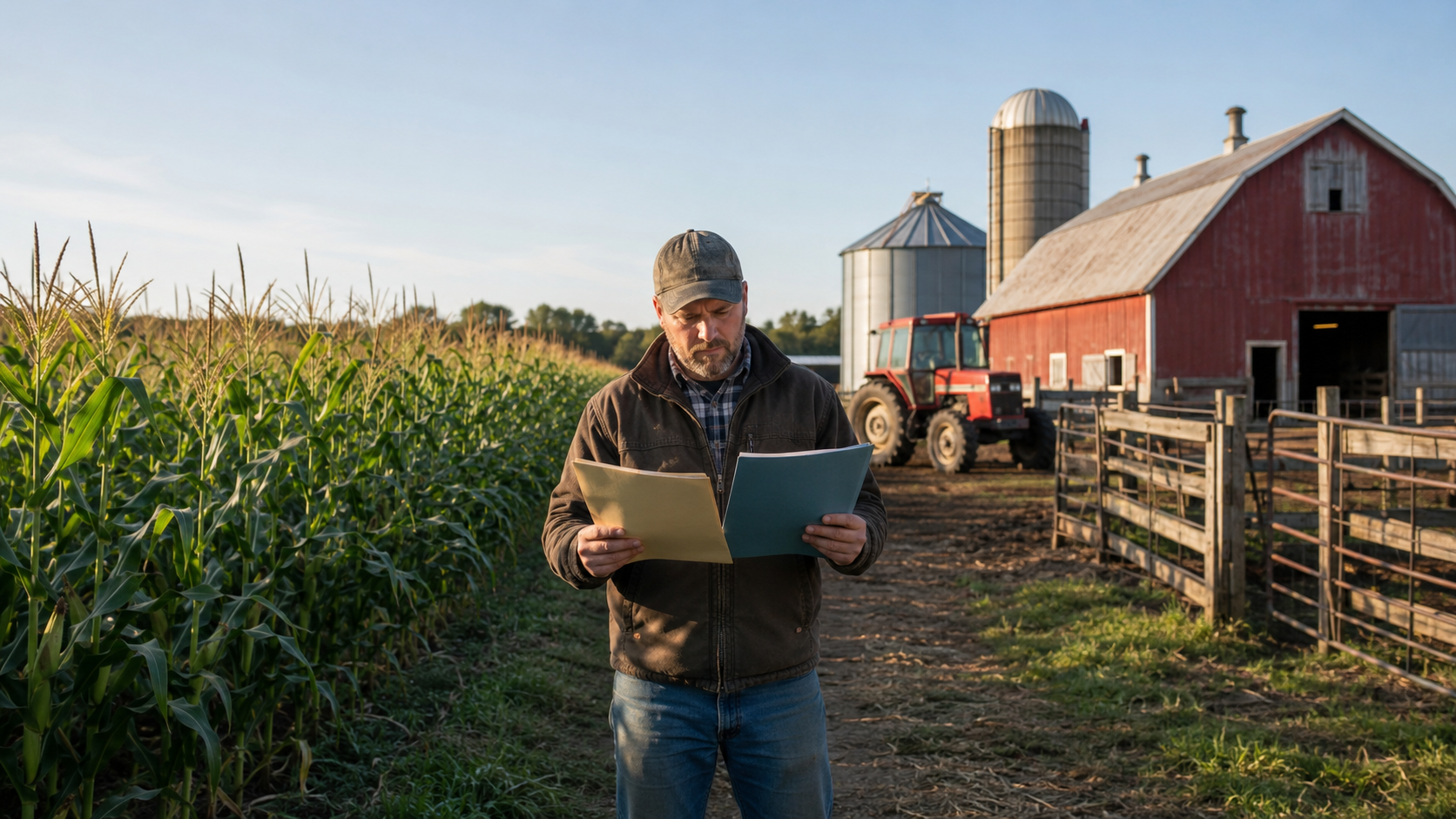
Agricultural insurance helps farmers and ranchers reduce the financial impact of events that can damage crops, lower revenue, kill livestock or interrupt farm operations. Depending on the policy, coverage may respond to drought, excessive moisture, hail, disease, falling commodity prices and other specified risks.
However, “agricultural insurance” is not a single standardized policy. It is a broad term covering several different products, including federal crop insurance, livestock coverage, whole-farm revenue protection and private farm property and liability insurance.
Understanding these differences is important. A crop policy that protects corn revenue, for example, generally will not replace a tractor damaged in a fire. Likewise, a farm property policy may protect a barn but not compensate the farmer for a drought-related reduction in crop yield.
This guide explains how agricultural insurance works in the United States, what the major policy types cover and what farmers should examine before purchasing coverage.
Key Takeaways
- Agricultural insurance is a broad category that includes crop, livestock, revenue, property and liability coverage.
- Most federal crop insurance is delivered through private insurance agents and approved insurance providers under rules administered by the USDA Risk Management Agency.
- Coverage, deadlines and available insurance products vary by crop, county and production practice.
- Farmers normally select a coverage level and pay part of the premium, while the federal government subsidizes eligible federal crop insurance premiums.
- A covered loss does not automatically produce a payment. The loss must meet the policy’s terms, deductible and reporting requirements.
- Farm buildings, machinery, vehicles and liability exposures usually require private farm or ranch insurance rather than a federal crop policy.
What Is Agricultural Insurance?
Agricultural insurance is financial protection designed for the risks associated with producing crops, raising livestock and operating a farm or ranch.
A policy transfers part of a defined agricultural risk from the producer to an insurance provider. The producer pays a premium and agrees to follow the policy’s conditions. If a covered event causes a qualifying loss, the insurance provider may issue an indemnity payment based on the policy’s formula and documented loss.
Agricultural insurance can protect different parts of an operation, including:
- Crop yield
- Crop revenue
- Livestock prices or revenue
- Pasture and forage
- Farm buildings
- Agricultural machinery
- Stored products
- Farm liability
- Business interruption
No single policy necessarily covers all these areas. A farm may need multiple policies to address its most significant risks.
Agricultural Insurance vs. Crop Insurance
The terms are related but not interchangeable.
Crop insurance focuses primarily on crop production or crop revenue. It may protect against a reduction in yield, a decline in price or a combination of the two, depending on the plan selected.
Agricultural insurance is the broader category. In addition to crop insurance, it can include livestock products, whole-farm revenue protection and private insurance for buildings, machinery and liability.
Farm insurance commonly refers to a private package protecting physical property and liability exposures. Its structure may resemble a combination of homeowners, commercial property and business liability coverage adapted to agricultural operations.
A diversified farm may therefore carry a federal crop insurance policy, a whole-farm revenue policy or livestock product, plus a private farm package for buildings, equipment and liability.
How Does Federal Crop Insurance Work?
The federal crop insurance program operates as a public-private partnership.
The Federal Crop Insurance Corporation administers the federal program, while the USDA Risk Management Agency, commonly called RMA, manages program rules, approved products, premium rates, subsidies and reinsurance arrangements.
Farmers do not normally purchase federal crop insurance directly from USDA. Licensed private crop insurance agents sell the policies, and USDA-approved private insurance companies service them.
Although agents and approved providers deliver the coverage, the terms of an eligible federal policy are governed by federal program rules. An agent cannot simply rewrite the policy to cover a risk that the applicable provisions exclude.
The basic process works as follows:
- The farmer identifies the crops, counties and production risks that need protection.
- A licensed crop insurance agent reviews the plans available for that crop and location.
- The farmer applies before the applicable sales closing date.
- The producer reports acreage, production history and other required information.
- The insurance provider calculates the guarantee and premium.
- Coverage attaches according to the policy’s provisions.
- The farmer reports a suspected loss within the required time.
- A loss adjuster investigates and documents the damage.
- The insurance provider calculates any indemnity due under the policy.
The federal government pays part of the premium for eligible federal crop insurance coverage. The farmer is responsible for the remaining producer-paid premium and any applicable administrative fees.
Major Types of Agricultural Insurance
Yield Protection
Yield Protection is designed to protect against a qualifying reduction in crop yield.
The guarantee is generally based on the producer’s approved yield, selected coverage level and an established price. If production falls below the insured guarantee because of a covered cause, the policy may pay an indemnity.
A simplified example illustrates the concept:
Suppose a farmer has an approved yield of 180 bushels per acre and selects a 75% coverage level. The yield guarantee would generally be:
180 × 75% = 135 bushels per acre
This does not mean every result below 135 bushels automatically produces the same payment. The actual calculation depends on the applicable policy, insured acreage, unit structure, price election, production records and verified cause of loss.
Revenue Protection
Revenue Protection addresses a combination of yield and price risk.
A farmer may produce a reasonable crop but still experience lower revenue because the relevant commodity price declines. Alternatively, production may fall even when market prices rise. Revenue-based coverage is designed to consider both elements according to the policy’s formula.
Revenue Protection should not be confused with a guarantee of farm profitability. It protects an insured revenue benchmark, not every operating expense or expected profit.
Actual Production History Coverage
Many individual crop policies use Actual Production History, or APH, to establish an approved yield.
The producer provides historical production records, and the insurance provider uses the applicable rules to calculate the approved yield. According to RMA’s insurance cycle guidance, an APH database generally contains a minimum of four and a maximum of ten crop-year yields. Transitional yields may be used when sufficient actual history is unavailable.
Accurate records matter because incomplete or incorrect production information can affect the guarantee, premium and claim calculation.
Area-Based Insurance
Area-based plans use results for a broader geographic area, such as a county, rather than relying only on the individual farm’s loss.
This structure can be useful when a producer’s yields tend to move with the county average. However, it creates basis risk: an individual farm can experience a serious loss without receiving a payment if the county-level result does not trigger the policy.
Farmers should understand whether a product measures their own operation or an external index before purchasing it.
Whole-Farm Revenue Protection
Whole-Farm Revenue Protection, or WFRP, protects revenue from multiple commodities under one policy.
It can be particularly relevant to diversified farms, specialty crop operations, organic producers and farms selling through local or direct markets. Rather than insuring only one crop, WFRP evaluates the farm’s overall insured revenue under program rules.
For the 2026 policy year, RMA states that WFRP offers coverage levels from 50% through 90%. Eligibility, insured revenue limits, documentation requirements and available options can change, so producers should verify the rules for the applicable policy year.
Livestock Insurance
Federal livestock products are structured differently from traditional animal mortality insurance.
For example:
- Livestock Risk Protection addresses covered declines in livestock prices.
- Dairy Revenue Protection addresses covered declines in milk revenue.
- Other livestock products may address specific price, margin, weight or revenue risks.
These products generally do not replace private mortality coverage for the death of an individual animal. Farmers must distinguish between price or revenue protection and coverage for physical loss, disease or death.
Pasture, Rangeland and Forage Coverage
Pasture, Rangeland and Forage insurance uses a rainfall index to help protect against reduced precipitation within a selected area and period.
The policy does not measure the producer’s actual forage production or rainfall at one specific farm. Payments depend on the applicable rainfall index. A farm can feel unusually dry without receiving a payment if the index does not meet the trigger specified by the policy.
Private Farm and Ranch Insurance
Federal crop insurance does not replace a private farm property and liability policy.
Private farm insurance may cover:
- Barns, sheds and other farm structures
- Tractors and agricultural machinery
- Tools and equipment
- Stored products
- Farm dwellings and personal property
- General liability
- Farm product liability
- Pollution liability
- Agritourism exposures
- Business interruption
Available coverage and exclusions vary significantly among insurance companies. Farmers should not assume a general farm policy automatically covers every structure, animal, employee, vehicle or commercial activity.
What Risks Can Agricultural Insurance Cover?
The answer depends entirely on the policy.
Federal multiple-peril crop insurance may cover unavoidable production losses caused by events specified in the policy, potentially including:
- Drought
- Excessive moisture
- Hail
- Freeze
- Wind
- Certain plant diseases
- Certain insect damage
- Natural fire
- Failure of irrigation water supply caused by an insured event
- Prevented planting, when the applicable provisions provide it
Revenue policies may also respond to defined price movements.
Private agricultural policies may cover fire, theft, vehicle accidents, machinery damage, liability claims and other property or business risks. These risks are not automatically included in federal crop insurance.
The policy provisions, crop provisions, special provisions and actuarial documents determine the actual coverage. A general list should never replace a review of the issued policy.
What Is Commonly Excluded?
Agricultural insurance does not protect a producer against every poor result.
Depending on the product, exclusions or limitations may involve:
- Failure to use recognized good farming practices
- Poor farm management
- Failure to plant or harvest within required timeframes
- Damage occurring before coverage attaches
- Losses reported after the policy deadline
- Inaccurate acreage or production reporting
- Ordinary wear and tear
- Mechanical breakdown without applicable equipment coverage
- Intentional damage
- Risks not listed as insured causes
- Market price changes under yield-only coverage
Some situations are highly fact-specific. A farmer should contact the insurance agent promptly instead of assuming that an event is covered or excluded.
How Are Agricultural Insurance Premiums Calculated?
There is no single national price for agricultural insurance.
Federal crop insurance premiums can be affected by:
- Crop
- County
- Insured acreage
- Production history
- Approved yield
- Coverage level
- Insurance plan
- Unit structure
- Production practice
- Commodity prices
- Premium subsidy
- Optional endorsements
Selecting a higher coverage level generally increases the amount of protection and may increase the farmer-paid premium. However, subsidy rates, unit choices and product structure can materially change the final cost.
Private farm insurance pricing may also consider building values, machinery, livestock, revenue, claims history, liability limits, location and safety controls.
A meaningful quote therefore requires information about the actual operation. National average prices rarely tell an individual farmer what a policy will cost.
How Does an Agricultural Insurance Claim Work?
The claim process begins with prompt notice to the agent or insurance provider.
RMA’s insurance cycle states that a federal crop insurance policyholder generally must provide notice of damage or loss within 72 hours of initially discovering it and no later than 15 days after the end of the insurance period, unless the individual policy says otherwise.
After receiving notice, the provider may assign a loss adjuster. The adjuster can inspect the crop, verify the cause and timing of damage, review production records and determine the remaining value.
Farmers should not destroy, abandon, replant or put damaged acreage to another use without first discussing the situation with the insurance provider. Doing so can interfere with inspection and claim documentation.
Useful records may include:
- Planting dates
- Acreage reports
- Production records
- Harvest records
- Sales records
- Input receipts
- Photographs
- Weather information
- Storage records
- Farm maps
If the provider determines that a covered indemnity is due, it issues payment according to the policy calculation. Outstanding premiums, interest or administrative charges may be deducted where permitted.
How to Choose Agricultural Insurance
Choosing coverage should begin with the farm’s most financially damaging risks—not with the cheapest available premium.
Farmers can ask the following questions:
- Which crops and counties are eligible?
- Is the policy based on individual production or an area index?
- Does it protect yield, price, revenue or physical property?
- Which causes of loss are covered?
- Which exclusions could affect this operation?
- What production records are required?
- How does the deductible work?
- How are coverage units structured?
- What are the sales closing and reporting dates?
- What actions are required immediately after a loss?
- Are prevented planting and replant provisions available?
- Does the farm need separate property, machinery or liability insurance?
The USDA RMA Agent Locator can help producers find licensed agents who sell federal crop or livestock insurance. Comparing service is also important because accurate reporting, annual reviews and claim assistance can be as valuable as the initial quote.
What If Federal Crop Insurance Is Not Available?
Not every agricultural commodity has a permanent federal crop insurance product in every county.
The USDA Farm Service Agency administers the Noninsured Crop Disaster Assistance Program, commonly known as NAP. It provides financial assistance for eligible noninsurable crops when certain natural disasters cause qualifying low yields, inventory losses or prevented planting.
NAP is not simply a substitute policy that automatically provides the same protection as crop insurance. It has its own eligibility rules, deadlines, fees, coverage options and reporting requirements.
A producer should speak with both a crop insurance agent and the local USDA Service Center when unsure which program is available.
Frequently Asked Questions
Is agricultural insurance mandatory?
Agricultural insurance is not universally required for every U.S. farm. However, lenders, contracts or participation in certain agricultural programs may create insurance or risk-management requirements. Producers should verify the conditions attached to their loans and government program participation.
Does agricultural insurance cover drought?
Many federal crop insurance products include drought as a covered cause of loss, subject to the applicable policy. Rainfall-index products may also respond when the relevant index falls below the selected trigger. Coverage should be confirmed for the specific crop, county and plan.
Does crop insurance cover hail?
Multiple-peril crop insurance may include hail among its covered causes. Farmers can also purchase private crop-hail insurance. The two products can have different deductibles, claim calculations and coverage periods.
Does crop insurance cover barns and tractors?
Federal crop insurance generally protects insured agricultural commodities or revenue—not barns, tractors and machinery. These assets typically require private farm property or equipment coverage.
Can a farmer purchase crop insurance after planting?
Applications must be completed by the applicable sales closing date. Deadlines vary by crop and location and may occur before planting. Applications submitted after the deadline generally are not accepted for that insurance cycle.
How quickly should crop damage be reported?
Under RMA’s general insurance cycle guidance, notice is usually required within 72 hours after the producer first discovers damage or loss and no later than 15 days after the end of the insurance period. Individual crop provisions may impose different or additional requirements.
Final Thoughts
Agricultural insurance works best as part of a broader farm risk-management plan.
Federal crop and livestock products can protect production, price or revenue, while private farm policies address buildings, machinery and liability. Diversified operations may also benefit from whole-farm revenue protection or specialized coverage.
The right combination depends on the farm’s commodities, location, production history, finances and tolerance for risk. Producers should review coverage annually, maintain accurate records and discuss changes in acreage, practices or marketing with a qualified agricultural insurance agent before the applicable deadlines.
This article is for general educational purposes and does not provide insurance, legal, tax or financial advice. Policy availability and terms vary by state, county, crop, insurance provider and policy year.
Sources and Further Reading
- USDA Risk Management Agency: Insurance Cycle
- USDA Risk Management Agency: Insurance Plans
- USDA Risk Management Agency: Agent Locator
- USDA Risk Management Agency: Whole-Farm Revenue Protection
- USDA Risk Management Agency: Livestock Insurance Plans
- USDA Farm Service Agency: Noninsured Crop Disaster Assistance Program